Monday, August 7, 2017

Rosehip and Honey Pannacotta – A Conspiracy Theory

Pin It When I travel, I love to taste local dishes on the grounds that if you order food in its natural environment, it is produced by people who love the dish and who know how it should taste.

Sometimes life and waiters conspire against me.

Happiness is... Rosehip and Honey Pannacotta

In the States, I have tried repeatedly to taste an authentic American cornbread. On each occasion, my order has been misheard (perhaps the Irish accent – “so charming honey”, but clearly unintelligible) or “the kitchen’s just out”.

If pannacotta was a flower it would be sweetpea
The same goes for Pannacotta. I have tried in Venice. I have tried in Verona. I have even tried several Italian restaurants in Ireland where surely they’d be used to the accent. On each occasion I have been brought a delicious dessert but not Pannacotta. Am I saying it wrong? Pah-nah-cot-ah?  PAHna COHtah? PannaCOTTa?
Straight from the hedgerows ;-)

This has happened so often that I have evolved a theory: Some people closely guard the location of their favourite restaurant in case it gets too popular... Perhaps, cornbread and Pannacotta are just too good to share.

Clearly, I am just going to have to make my own to find out.

For 6 servings you will need...
...to lightly oil 6 ramekins, cups or moulds with a flavourless oil
4 sheets of gelatine
250mls double (heavy) cream
300mls Greek yoghurt
60g runny honey
50mls rosehip syrup or cordial (undiluted)


Rosehip and Honey Dressing
2 tablespoons runny honey
1 tablespoon rosehip syrup or cordial (undiluted)

A selection of fresh berries to serve


1                    Place the gelatine in a bowl of cold water and leave it for about 5 minutes to soften.
2                    Meanwhile, in a medium saucepan heat the cream and honey together until just simmering at the edges. Remove from the heat.
3                    Drain off the water from the gelatine and squeeze out any excess. Replace in the empty bowl and add a little of the hot cream mixture. Stir together until the gelatine has dissolved completely. Pour the gelatine mixture into the saucepan and stir to disperse it through the liquid. Add in the Greek yoghurt and stir the mixture with a whisk until the yoghurt has blended smoothly into the liquid. Don’t go too crazy with the whisk. You don’t want to incorporate loads of bubbles into the mixture.
4                    Finally, stir in the rosehip cordial or syrup until dispersed through the mixture. Divide between the oiled containers. Cover with cling film and refrigerate until set (at least 6 hours – or overnight if possible).
5                    Just before serving, make the Rosehip and Honey Dressing by mixing together the honey and syrup/cordial until combined.
6                    To remove the Pannacotta from each container, sit them briefly into hot water until they loosen at the edges, then cover with a serving plate and flip over. If Murphy’s Law doesn’t come into play, you’ll end up with a perfect Pannacotta ready to be surrounded by fresh berries and drizzled with Rosehip and Honey Dressing.

Make it the day before for a super-easy delightful dessert
(If Murphy’s Law does come into play, or you get distracted, it could end up on the floor...)
Pin It

Thursday, July 20, 2017

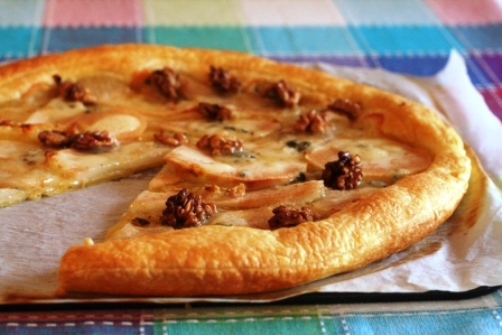
Pear, Walnut and Roquefort Tart – exceptionally lazy (and tasty!)

Pin It
An exceptionally lazy (and tasty) tart


If I get reincarnated as a mouse, I am in big, big trouble because - quite apart from grey not being my best colour - in general (gasp!) I don’t like cheese very much. This is a major failing which I try to correct. When I find myself faced with a cheeseboard, I will taste a molecule of everything just to make sure I still don’t like it. Mostly, I still don’t.

One of the few exceptions is creamy, salty Roquefort, which I treat as a seasoning - for salads and for this exceptionally lazy tart. So simple, this is barely a recipe, however the pastry must be good quality all butter pastry - there is nowhere for anything less to hide.

For 1 lazy tart (a quick snack for 2 or a canapĂ© for 4 – 6) you will need…
… to pre-heat the oven to 190˚C

1 x 220g sheet of ready-made all butter puff pastry
1 large sweet pear (such as Comice) peeled and very thinly sliced
50g Roquefort, cut or crumbled into pieces about the size of a hazelnut
25g walnut halves
10g salted butter

1.                 Using a sharp knife, score a line around the edge of the pastry sheet about 2cm from the edge, being careful not to cut all the way through.
2.                 Taking care to avoid the margin you’ve just created, arrange the pear slices in one layer on top of the pastry. At this point the tart looks very mean and you’ll be tempted to add more pear slices. Hold your nerve. The tart will be soggy if you overdo the fruit. Distribute the pieces of cheese evenly over the surface of the tart, followed by the walnut halves. Dot the pieces of pear with the salted butter. Place in the pre-heated oven and bake for 12 – 15 minutes until the pastry is golden and cooked through and the cheese melted. Serve hot or warm.

A cheesy snack for gourmet mice ;)


Variation: You could drizzle a little clear honey over the top of the cooked tart for a little hit of sweetness.
Pin It

Monday, June 12, 2017

Lemon, Honey and Basil Ice Cream - it'd be a crime to miss it !

Pin It


Some years ago a very pleasant trip to visit a friend in France took a rather strange twist that involved a very unique (and ever so slightly stolen) car, being fingerprinted by French police (who also offered great advice on where to dine in the vicinity), and a lemon. Long story.  I’ll tell you when you come round to visit.
I was given the lemon, as a souvenir of this strange adventure, which I took back to Ireland and made into ice cream. It was the first ice cream I ever made and was a convoluted process. Was it the most exciting ice cream I’ve ever tasted? No. But it served to send me on a quest for a lemony ice cream that would create for my taste buds a little of the excitement of that trip, and here it is.

Strictly speaking, this is a frozen yoghurt but because it is Greek yoghurt it is every bit as satisfyingly creamy as an ice cream. It is also dead easy to make. With such a high juice content, you really do need an ice cream maker for this. Note: This ice cream is for grown-ups.

For 4 - 6 servings you will need...
... an ice cream maker

Zest of 2 lemons, grated
Zest of 1 orange, grated
175mls fresh lemon juice
75mls fresh orange juice
10g fresh basil leaves
140g runny honey
550g Greek yoghurt
¼ teaspoon sea salt 

1                    Place everything except the Greek yoghurt in a small saucepan and bring to the boil. Immediately remove from the heat and leave to cool. Strain to remove the zest and basil leaves. Leave to cool, then chill in the refrigerator for about 30 minutes.
2                    When chilled, mix with the Greek yoghurt and salt and churn in your ice cream maker according to manufacturer’s instructions. When the mixture has thickened to ice cream, transfer it to a freezer container and place in the freezer for 24 hours. Although it is ready to eat straight away, the flavours develop further if you can bear to wait until the following day. Before serving, allow to soften in the fridge for 20-25 minutes.

Taste-tester verdict: "Gasp!" but in a good way. 
Pin It

Friday, May 5, 2017

White Chocolate and Raspberry Paris-Brest - they're wheel-y wheel-y delicious!

Pin It


Who doesn’t, at some stage, have lonely egg yolks languishing in their fridge. There they sit, dreaming of a better life, (cue violins) until one day the fridge door opens... light floods in... and their crusted remains are consigned to the bin. Awwwwww...


"I coulda been a contender. I coulda been been somebody..." Eggy Malloy, On the Waterfront
The talented and lovely Jill Colonna, author of Mad About Macarons le book, and le blog (and now Teatime in Paris) threw down the gauntlet of the egg yolk challenge and I happily accepted an invitation to guest post on what was then the first anniversary of Alchemy, back in 2011. 
The egg yolk challenge was a great idea because we've all had a bowl of forlorn egg yolks sitting in the fridge at some point. Having been parted from their whites – who have gone on to star as Magnificent Macarons, Marvellous Meringues, or Superb SoufflĂ©s – the poor old yolk tends to be forgotten.
Egg yolks can achieve greatness too. After all, Botticelli painted The Birth of Venus using egg yolk-based paint. While Botticelli provided a feast for the eyes, here is something you can actually get your teeth into.  Gateau Paris-Brest is a delectable choux pastry, named after the famous Paris – Brest bicycle race. The shape represents a wheel. Here it is in miniature, my Summery version with raspberries and white chocolate pastry cream.

L'inspiration - a velo at Saint-Guilhem-le-DĂ©sert (which I always read as 'dessert'...)
For 10 – 12 gorgeous little pastries you will need…
Pastry Cream (crème pâtissière)
300mls fresh milk
50g caster sugar
½ teaspoon vanilla extract
a pinch of salt
15g plain flour
15g cornflour
4 egg yolks
50g good quality white chocolate, chopped

Heat the milk in a medium saucepan until just simmering.

Meanwhile, in a medium mixing bowl, whisk the egg yolks together with the vanilla extract and sugar until thick and paler in colour. Add in the salt, plain flour and cornflour and whisk until incorporated.

Slowly add the simmering milk to the egg yolk mixture, whisking all the time (never add cold eggs to hot liquid unless you want scrambled eggs). Mix well and return the liquid to the saucepan. Continue to whisk over a low heat until the liquid has become a thick custard. This will take about 3 or 4 minutes. Make sure not to boil the custard or it will become grainy and may scramble. The custard is thick enough when it coats the back of a wooden spoon and a finger pulled though this coating leaves a clean trail.

Add in the white chocolate and stir until it has melted into the custard.
Transfer to a bowl and cover with cling film, making sure the cling film makes contact with the surface to prevent a skin from forming. Chill until ready to use. This can be prepared ahead and will keep in the refrigerator for several days.

Egg yolks – in the right company – are capable of greatness too


Choux Pastries
150mls water
50g butter
70g strong white flour/plain flour
A pinch of fine salt
2 eggs beaten
25g flaked almonds

You will also need a punnet of fresh raspberries

when you are ready to bake the choux wheels.

Heat the water and butter together in a medium saucepan until the butter has melted and the liquid is simmering

Carefully tip the flour and salt into the liquid in one go. Stir with a wooden spoon until the mixture comes together in a soft ball of paste and no dry flour remains. Spread the ball of paste over the bottom of the saucepan and leave to cool to room temperature.

When the paste has cooled, add in the beaten egg a little at a time, whisking well between additions. An electric whisk is best for this job. You want a smooth glossy soft paste that will hold its shape so check the mixture as you go along as you may not need to add all the egg.

Pre-heat the oven to 200°C (fan oven).  Transfer the mixture to a piping bag and pipe circles of the mixture (approximately 8cm/3 inches in diameter) onto a lightly buttered baking tray, leaving 5cm/2 inches between circles. Scatter the tops of the circles with almond flakes and transfer to the oven. Bake for approximately 15 minutes or until evenly golden brown. Remove from the oven and poke 2 horizontal slits in the side of each pastry to release some steam. Return to the oven for a further 2 minutes before removing to cool on a wire rack.

Assemble the little pastries just before serving: slice them in half horizontally. Beat the cooled pastry cream until smooth. For a really decadent touch, I sometimes stir a tablespoon of mandarin brandy into the pastry cream at this stage. Pipe onto the lower half of the pastry wheel and add fresh raspberries. Replace the top and dust with icing sugar.

These little pastries are perfect snack as you cycle from Paris to Brest, or perhaps keep a few beside your easel for energy as you paint a Renaissance masterpiece – using egg-yolk-based paint of course!


We taste wheel-y wheel-y delicious!

Pin It

Sunday, April 9, 2017

Ginger-roasted Rhubarb Cake with Vanilla Crumble Topping – catch it while you can!

Pin It
A sheaf of plump rhubarb has sat pride of place on the kitchen table for the past week. The world is its oyster. It could be anything it wants to be...  but it is just sat there. It needs direction. Here are a few ideas as to what it might become...

The world is my oyster apparently ...
 A career as rhubarb fool would be fun and rather light-hearted, but it looks like serious rhubarb to me.
Perhaps a career as a crumble or a tart? A little too serious maybe - and besides tarts and crumbles are wintery food and look at that beautiful sunshiny day!
Well then, how about rhubarb and vanilla ice cream? Delightful, but it’s only April and while sunshiny, it’s hardly ice cream weather is it? Let’s save that one for another occasion.
I know! This sheaf of rhubarb has everything it takes to become a successful and delectable ginger-roasted rhubarb cake. Oh alright, I’ll throw in a vanilla crumble topping too.
For approximately 10 servings you will need...
Ginger-roasted rhubarb
300g rhubarb, cut into bite-sized pieces
75g Muscovado sugar
1 teaspoon finely grated fresh ginger

Sugar and spice - ginger-roasted rhubarb
Pre-heat the oven to 180°C
1          Combine all the ingredients in a shallow pie dish and bake for 20 minutes in the pre-heated oven, stirring carefully once or twice during cooking so that the rhubarb is evenly coated in the syrup that is generated. When the cooking time has elapsed, remove from the oven and allow to cool. Meanwhile, prepare the vanilla crumble topping.

Vanilla crumble topping
120g butter, chilled and cut into about 10 cubes
75g plain flour
75g rolled oats
50g Muscovado sugar
1 teaspoon vanilla extract

1          Place all the ingredients into a food processor and blitz in short bursts until roughly combined. Chill until ready to use. (The quantities given make about twice as much crumble topping as you’ll need for this cake but it freezes beautifully for next time.)
2         Next, make the cake batter.

Cake batter
200g plain flour
2 teaspoons baking powder
a pinch of salt
175g caster sugar

100mls sunflower oil
50mls freshly squeezed orange juice (or milk)
½ teaspoon vanilla extract (or rose water)
2 eggs, beaten

a small knob of butter for greasing the tin

Pre-heat the oven to 170°C
1          Butter and baseline a 23cm (9 inch) sandwich tin.
2          In a large mixing bowl or stand mixer, combine the first 4 ingredients.
3          In a measuring jug or batter bowl, combine the oil, orange juice, vanilla extract and eggs and add to the bowl of dry ingredients, mixing until well combined.
4          Pour half the batter into the prepared tin. Drain any excess syrup from the rhubarb (this is good spooned over ice cream) and scatter the cooled pieces on top of the batter, leaving a small margin around the edges. Spoon the remaining batter on top. Don’t be too fussy about covering up all the rhubarb as you'll be covering it with crumble.
 5         Scatter the crumble mix over the top and bake in the pre-heated oven for 40 minutes or until well risen and golden on top. A cocktail stick inserted in the middle should come out clean. Remove from the oven and allow to cool in the tin.  


Catch me while you can!

This is really good served slightly warm, with a dollop of whipped cream, and is even better the following day when the flavours have had a chance to develop (but it rarely hangs round long enough for that to happen).

Pin It

Saturday, March 18, 2017

Leek Tart - a case for poireaux!

Pin It
I am the picnic’s most dedicated fan. I’ve been known to picnic in rain and snow. The weather doesn’t matter so long as I have a beautiful view, a dry place to sit and something delicious to eat.
A leek tart is perfect picnic food!
Excellent picnics have included:
·                    Glendalough in Co. Wicklow – bypass ‘picnic central’ near the car parks... try not to get distracted by picnic envy... there’s a thousand wonderful meals covering the wooden outdoor tables and spicy barbeque aromas rise into the air to tantalise... keep walking... find spot near lake... lay out picnic blanket. Eat, relax, sigh, and think “heaven!”
An unexpected companion at a recent picnic...

·                    Sittin' on the dock of the bay / Watching the tide roll away”, feet dangling in the water at the edge of Sausalito, with the obligatory ‘Californian’ on rye from a nearby Deli, a Coke and a smile.
Not a great day for a picnic but pretty view of Dalkey Island from Killiney Beach

·                    Hardboiled eggs washed down with red lemonade on Killiney beach, Co. Dublin, following a swim in cold, cold water with a view to rival the bay of Naples.
The best picnics are those shared. I wait with eager anticipation as the treasures concealed by picnic baskets are finally revealed and laid out on table or blanket ready to be handed around.
My favourite picnic items – apart from the obligatory nostalgia of hardboiled eggs dipped in sea salt – are pies and tarts. Sweet or savoury, it doesn’t matter. What does matter is that they are simple and tasty - like this leek tart – or Tarte aux Poireaux if you want to get fancy. Crumbly pastry, rich savoury filling, great company - sunshine is optional. Buy decent ready-made pastry for even less effort, however the pastry given below is very well-behaved so even if you are a pastry virgin why not give it a whirl.
For 4 tarts you will need:
Shortcrust Pastry
110g plain flour
a pinch of salt
½ teaspoon paprika
75g butter
1 egg yolk
a little iced water

1                    Place the flour, salt, paprika and butter in a food mixer or processor and blitz until the mixture resembles fine bread crumbs.
2                    Add the egg yolk and as much iced water – a tablespoonful at a time - as it takes to bring the mixture together into a soft (but not sticky) ball of pastry.
3                    Flatten the pastry into a disc, cover and refrigerate while you make the filling.
Luscious leek filling
50g butter
450g finely shredded chopped leeks
4 egg yolks
200g crème fraiche or 200ml fresh cream
50g Gruyere cheese
½ teaspoon sea salt
Freshly ground black pepper
a further 25g Gruyere cheese for sprinkling over the top

1                    Melt the butter in a large frying pan over a gentle heat. Add in the shredded chopped leeks. Stir to coat the leeks in the melted butter, then cover and leave to cook without colouring for about 10 minutes or so, stirring occasionally. When the leeks are meltingly tender, take them off the heat and transfer to a mixing bowl to cool.
2                    Meanwhile mix together the egg yolks, the crème fraiche or fresh cream, 50g Gruyere cheese and sprinkle in the salt and pepper.
3                    Pre-heat the oven to 180°C (350°F).
4                    Roll out the pastry to approximately the thickness of a 20c coin (GB 2p coin/USA 5c coin) and use to line 4 mini-quiche dishes or flan tins.
5                    Now add the eggy cheesy mixture to the cooled leeks, mixing well.
6                    Spoon the mixture into the pastry cases and sprinkle with the remaining 25g Gruyere.
7                    Bake in the pre-heated oven for 30 minutes or until the mixture is light golden brown and the cheese has melted.
That’s tonight’s supper for two sorted! It’s going to be served warm with a green salad. The remaining two tarts will accompany me on a picnic tomorrow – even better served cold somewhere the view will add a little alchemy of its own.
Pin It

Tuesday, February 7, 2017

PÄ…czki Tuesday – an exciting alternative to Shrovetide pancakes

Pin It
Since I went to see the highly energetic 'percussive dance' troupe Stomp the other evening, I have been making quite a racket. I have broken one wooden spoon (a tap-a-tap, a tappity tap) and the yard brush has seen better days. I don’t think it was ever constructed to be a percussion instrument (swish, swish, bang, swish). When I found myself eyeing the dustbin with new interest - such potential for noise ‘percussive dance’! - it was time to call a halt.
It's Stomp's fault...
I am left with a craving for doughnuts - also the fault of Stomp. They do this comical routine using the inner tubes of tractor tyres as outsized tutus. Think ‘streetwise doughnuts’ meet bizarre ‘corps de ballet’.
Looking for an excuse to satisfy my doughnut craving, I discovered that PÄ…czki [POHNCH-kee] are traditionally served in the lead up to Lent, on Fat Thursday and more recently, on Shrove Tuesday. These Polish jam doughnuts make an exciting alternative to Shrovetide pancakes, and if I happen to stamp out the doughnut shapes in a Stomp-like fashion, I’m sure it will only make them taste even better.
For 2 dozen doughnuts you will need...
250mls fresh milk
1 packet dried yeast

4 eggs
75g caster sugar
1 teaspoon vanilla essence
1 teaspoon salt
1 teaspoon lemon zest
700g strong white flour
100g butter, softened

Cooking oil for deep frying – I use sunflower oil

6 tablespoons damson (or your own favourite) jam for filling, sieved
Caster sugar or icing sugar for coating

As this is quite a sticky dough, it is best to use an electric mixer.
1          Warm the milk to between 27°C - 35°C (this is when a finger dipped in the milk will feel neither hot nor cold – but best to use a thermometer) and add the yeast.  Leave in a warm place for about 10 minutes or until the surface of the milk is slightly foamy.
2          Meanwhile, place the eggs, caster sugar, vanilla essence, salt and lemon zest in a large bowl and whisk until pale yellow and slightly thickened. Swap the whisk for a dough hook before adding the flour to the egg mixture, a little at a time, mixing well between additions.
3          Add the yeast mixture now, mixing until combined. Finally, add the softened butter in walnut–sized lumps, ensuring each addition is combined before adding the next. Continue kneading with the dough hook for a further 5 minutes. Cover with a lightly oiled sheet of cling film and leave in a warm, draught-free place to rise for 2 hours or until doubled in size. (You could make the dough in advance and leave it in the fridge to rise overnight, before continuing with the recipe).
Somewhat deflated...
4          Punch the risen dough to knock it back. It will deflate alarmingly. Turn the dough onto a lightly floured or lightly oiled work surface and knead lightly until you have a smooth ball of dough. Roll out to a thickness of about 1.5cm and stamp out rounds using a 6cm round scone cutter. Cover with lightly oiled cling film and leave to rise in a warm, draught-free spot for a further 30 minutes or until doubled in size.

Hubble, bubble, (no) toil and (no) trouble...

5          Heat the cooking oil to 180˚C (360˚F). Lower the doughnuts into the hot oil, a few at a time, without overcrowding. Fry for approximately 1 minute then turn over to continue frying on the other side for a further minute. When evenly golden brown, remove and drain on a thick wad of kitchen paper.

Inject jam with a Bismarck nozzle

6          Fill with jam while still warm: with the tip of a knife, make a small hole in the waist of each doughnut and using a piping bag fitted with a Bismarck nozzle, inject jam into the centre of each doughnut. Roll in caster sugar or dredge with icing sugar. Apply to face. Grin happily.

Apply to face... grin happily...
Note: If it occurs to you to cut the fat content by baking these instead of deep frying, please don’t! There is no comparison. My advice is: go the whole hog, but not too often!
Pin It