Showing posts with label Pancakes. Show all posts

Tuesday, April 26, 2022

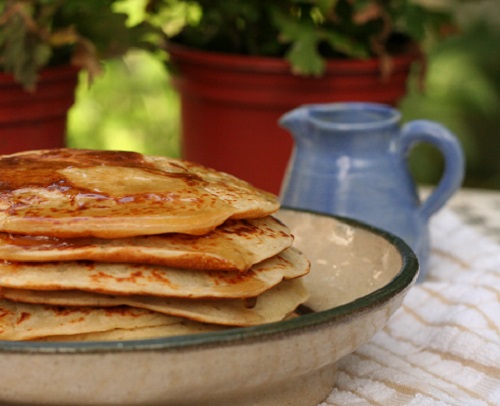
Boxty – out of the laundry room and into the frying pan

Pin It
Out of the laundry room and into the frying pan
(the gorgeous bowl and jug are by my aunt, Patricia Casey, artist and potter extraordinaire)

Writing in The Medical Times and Gazette in 1865, Henry MacCormac M.D., of Belfast, mentions the preparation of Boxty or ‘poorhouse bread’.

“The country people prepare, for purposes of laundry, potato starch. Raw potatoes are peeled, grated and washed. The gratings from which the boxty cake is made remain in the colander. This boxty cake … has a peculiar but not unpleasant flavour. I remember having partaken of it… in one of the houses of the peasantry.”

Thanks Henry, I know there were particular reasons for such frugality at the time, but that sounds really, really grim. No wonder Boxty isn’t our national dish!

As if that weren’t bad enough, a traditional rhyme suggests that if you were a female at that time, and this concoction wasn’t in your repertoire, you were in big trouble: Boxty on the griddle /Boxty in the pan / If you can’t make boxty / You’ll never get a man. Yikes!

Mercifully, laundry methods, society, and potato cuisine have all moved on since the dark days of the nineteenth century. You'll find that Boxty can be a type of potato cake, a dumpling or a pancake. Today’s recipe is for the pancake. My preference is for the floury Rooster potato but any floury potato will do.


For approximately 12 boxty pancakes you will need…

350g freshly boiled and mashed potato
50g butter
250g raw potato, finely grated
250g plain flour
1 teaspoon fine table salt
1 teaspoon baking powder
¾ teaspoon bread soda
350mls buttermilk

A little sunflower oil or extra virgin olive oil for frying

Mix the butter with the freshly made mashed potato while it is still hot. Leave to cool.

Meanwhile, wring the grated potato out in a clean tea towel to extract as much liquid as possible. (Discard the liquid.)  Add the grated potato to the cooked mashed potato along with the flour, salt, baking powder and bread soda and mix to combine.

Gradually mix in the buttermilk to form a thick batter.

Now, heat a frying pan over a medium heat. Wipe the hot pan with a wad of kitchen paper dipped in sunflower oil, giving the pan the barest sheen of oil. (Keep the oily paper to wipe the frying pan between cooking each pancake.)


Fry gently until the surface of the batter has set

Scoop about 80mls of batter into the pan and quickly smooth it out to form a circle. Fry gently until the surface of the batter has set, then flip the pancake over. Continue cooking for a further 30 seconds or so, or until the pancake is golden brown. Repeat until all the batter has been used up, keeping the cooked pancakes warm in a low oven.

Serve as part of a cooked breakfast or drizzled in maple syrup.


Variation:
I make tiny versions of these as an alternative to blinis and serve with smoked salmon and crème fraiche.

Pin It

Tuesday, July 16, 2019

Crumpets – in Search of the Hole-y Grail

Pin It


Indiana Jones had it easy. To find his Holy Grail, he merely had to deal with rats, fire, gunmen, betrayal and avoid being chopped to bits by a ship’s propeller. Mr Jones would have paled in the face of my mission – to make the Holey Grail of the griddle cake world – the perfect crumpet.
So, what constitutes the perfect crumpet?
According to my true blood English crumpet connoisseur, it must be: “light and fluffy with lots of holes in it, but it has to have a certain chewy bite to it. It is best eaten toasted and dripping with butter, which needs to soak through the holes. The holes are very important.”
Being Irish, perhaps I don’t fully appreciate the finer nuances of this yeasty little devil which is little known in the Emerald Isle. Perhaps it is ignorance that allows me to laugh in the face of such a challenge. Bring it on, I say - oh, and don’t forget the butter!

For 12 – 14 crumpets, enough for 4 – 6 people, you will need...
... crumpet rings*
125g strong white flour
125g plain flour
1 x 7g sachet of quick action dried yeast
2 teaspoons caster sugar
1 teaspoon fine salt
350mls water
1 tablespoon extra virgin olive oil (or melted butter)
1/2 teaspoon vanilla extract

Butter for greasing the crumpet rings

Method 
Place the strong flour, plain flour, yeast, sugar and salt in a mixing bowl and stir to combine.
Heat the water to between 27°C – 35°C. (This is approximately when the water feels neither hot nor cold. Too hot, it will kill the yeast. Too cold, it will just take longer to activate.) Add the olive oil (or melted butter) and vanilla extract to the warm water.
Make a well in the centre of the flour mixture and slowly add the water, incorporating the flour from around the edges, mixing to a thick smooth batter. Cover and leave in a warm place until the surface is covered with little bubbles (about 90 minutes).
Grease the crumpet rings well with butter and place them in a large frying pan over a medium heat - 4 fit snugly in my frying pan so I make them in 3 or 4 batches.
Rub the frying pan with a little butter, just within the area crumpet rings. Wait until the butter has melted and the rings are hot (otherwise the batter will stick horribly and you’ll never want to make crumpets again).
Fill the crumpet rings a little over half way – they’ll rise further as they cook. I use about 60mls of batter per crumpet. Cook gently until the top looks dry and is full of holes - about 5 to 7 minutes. Turn the crumpets over, and remove the rings if they will come away easily. Cook the crumpets for a further minute or so, until golden. Traditionally, crumpets are cooked only on one side but this results in a pale unattractive bread.
You can cool them on a wire rack and freeze them at this stage, for later revival in a toaster - which is the preferred manner of many crumpet fanciers. However, I prefer them fresh from the frying pan, smothered in butter - and large doses of an excellent homemade plum jam I was given recently.

*If you don’t have crumpet rings, melt a knob of butter in a frying pan over a medium heat. Spoon the batter into the pan to form little cakes – about 2 tablespoons of batter per cake. A crumpet without the support of a crumpet ring is called a pikelet – and is just as good.

Crumpet Connoisseur Verdict:
Light and fluffy? Check!  Lots of holes? Check !  A certain chewy bite? Check !
Would you like another - just to be sure ? Check, check, check !
 
Pin It

Monday, February 11, 2013

Cider and Cinnamon Crêpes - Time to practice your pancake-flipping skills!

Pin It

Pancake Day nearly slid by unnoticed in the shadow of the fast-approaching Valentine’s Day chocolate fest. Eeek!
Although I nearly always go for fluffy American pancakes, Shrove Tuesday (Mardi Gras, Fat Tuesday, Pancake Tuesday) calls for more traditional crêpe-style pancakes - the last hurrah before the lean Lenten days ahead...
I like my pancake accompaniments fairly simple - a drizzle of honey, a squeeze of lemon – so I’ve put the flavour in the batter by adding cider, vanilla and cinnamon. The kitchen smells like a Yankee Candle store while these are cooking.

For 8 – 10 pancakes you will need...
... a crêpe pan (a non-stick frying pan will do but a lightweight crêpe pan makes life easier)

125g plain flour
a pinch of fine table salt
¼ teaspoon ground cinnamon
2 large eggs
125mls milk
100mls natural cider, unsweetened, non-sparkling (or unsweetened natural apple juice)
2 tablespoons sunflower oil
½ teaspoon vanilla extract 

To serve: a juicy lemon, cut into generous wedges, and honey or icing sugar

1                    In a mixing bowl, combine the flour, salt and ground cinnamon. Make a well in the centre of the flour and add the eggs. Whisk the eggs, gradually incorporating the flour from the edges. When the eggs are combined with the flour, gradually whisk in the milk, followed by the cider (or apple juice), sunflower oil and vanilla extract continuing to whisk until you have a smooth batter. This can rest in the fridge until you are ready to cook.
2                    When you are ready to make the pancakes, heat a non-stick over a medium-high heat. When the pan is hot, rub it with piece of kitchen paper dipped in oil.
3                    Pour approximately 60-70mls of batter into the pan to form a pancake approximately 8 – 10cm in diameter. As the batter hits the hot surface, tilt the pan slightly in a circular motion so that the batter spreads out evenly.
4                    Cook for about a minute or until the pancake loosens when the pan is shaken back and forth. Slide an egg-slice or spatula under the pancake and carefully turn it to continue cooking for another minute. (Now could be the time to test your pancake-flipping skills...)
5                    Serve immediately with wedges of lemon and sugar or honey.
Happy Pancake Day!
Pin It