Tuesday, February 7, 2017

Pączki Tuesday – an exciting alternative to Shrovetide pancakes

Pin It
Since I went to see the highly energetic 'percussive dance' troupe Stomp the other evening, I have been making quite a racket. I have broken one wooden spoon (a tap-a-tap, a tappity tap) and the yard brush has seen better days. I don’t think it was ever constructed to be a percussion instrument (swish, swish, bang, swish). When I found myself eyeing the dustbin with new interest - such potential for noise ‘percussive dance’! - it was time to call a halt.
It's Stomp's fault...
I am left with a craving for doughnuts - also the fault of Stomp. They do this comical routine using the inner tubes of tractor tyres as outsized tutus. Think ‘streetwise doughnuts’ meet bizarre ‘corps de ballet’.
Looking for an excuse to satisfy my doughnut craving, I discovered that Pączki [POHNCH-kee] are traditionally served in the lead up to Lent, on Fat Thursday and more recently, on Shrove Tuesday. These Polish jam doughnuts make an exciting alternative to Shrovetide pancakes, and if I happen to stamp out the doughnut shapes in a Stomp-like fashion, I’m sure it will only make them taste even better.
For 2 dozen doughnuts you will need...
250mls fresh milk
1 packet dried yeast

4 eggs
75g caster sugar
1 teaspoon vanilla essence
1 teaspoon salt
1 teaspoon lemon zest
700g strong white flour
100g butter, softened

Cooking oil for deep frying – I use sunflower oil

6 tablespoons damson (or your own favourite) jam for filling, sieved
Caster sugar or icing sugar for coating

As this is quite a sticky dough, it is best to use an electric mixer.
1          Warm the milk to between 27°C - 35°C (this is when a finger dipped in the milk will feel neither hot nor cold – but best to use a thermometer) and add the yeast.  Leave in a warm place for about 10 minutes or until the surface of the milk is slightly foamy.
2          Meanwhile, place the eggs, caster sugar, vanilla essence, salt and lemon zest in a large bowl and whisk until pale yellow and slightly thickened. Swap the whisk for a dough hook before adding the flour to the egg mixture, a little at a time, mixing well between additions.
3          Add the yeast mixture now, mixing until combined. Finally, add the softened butter in walnut–sized lumps, ensuring each addition is combined before adding the next. Continue kneading with the dough hook for a further 5 minutes. Cover with a lightly oiled sheet of cling film and leave in a warm, draught-free place to rise for 2 hours or until doubled in size. (You could make the dough in advance and leave it in the fridge to rise overnight, before continuing with the recipe).
Somewhat deflated...
4          Punch the risen dough to knock it back. It will deflate alarmingly. Turn the dough onto a lightly floured or lightly oiled work surface and knead lightly until you have a smooth ball of dough. Roll out to a thickness of about 1.5cm and stamp out rounds using a 6cm round scone cutter. Cover with lightly oiled cling film and leave to rise in a warm, draught-free spot for a further 30 minutes or until doubled in size.

Hubble, bubble, (no) toil and (no) trouble...

5          Heat the cooking oil to 180˚C (360˚F). Lower the doughnuts into the hot oil, a few at a time, without overcrowding. Fry for approximately 1 minute then turn over to continue frying on the other side for a further minute. When evenly golden brown, remove and drain on a thick wad of kitchen paper.

Inject jam with a Bismarck nozzle

6          Fill with jam while still warm: with the tip of a knife, make a small hole in the waist of each doughnut and using a piping bag fitted with a Bismarck nozzle, inject jam into the centre of each doughnut. Roll in caster sugar or dredge with icing sugar. Apply to face. Grin happily.

Apply to face... grin happily...
Note: If it occurs to you to cut the fat content by baking these instead of deep frying, please don’t! There is no comparison. My advice is: go the whole hog, but not too often!
Pin It

Sunday, January 8, 2017

Sweet Vanilla Scones – Worth getting out of bed for!

Pin It

A big jug of coffee had just been set in the hearth, the seed-cakes were gone, and the dwarves were starting on a round of buttered scones, when there came- a loud knock. 
The Hobbit, J.R.R. Tolkien

In my house the loud knock came before the scones, and it wasn't a rat-tat on a Hobbit door, but my bedtime reading (Neil Jordan’s ‘Mistaken’) falling off the bed and crash-landing on the floor, which startled me out of dreamland. There was no going back to sleep and 2 doses of BBC drama and the news headlines later, I gave up and decided to have an early, early, early breakfast that was worth getting up for on a dark frosty morning.

I had Sweet Vanilla Scones mixed and in the oven in the time it took to brew a proper pot of Rosie Lee under a tea cosy. I poured out the first mug of the day and curled up on the sofa to devour another chapter until my nose (and my digital timer) told me it was time to take the scones out of the oven and make another brew.

For 12 plain and simple sweet vanilla scones you will need...
... to preheat the oven to 180°C
350g plain flour
12g baking powder
a pinch of fine table salt
100g butter, from the fridge, cut into small cubes
2 tablespoons of caster sugar
½ teaspoon vanilla extract
120mls fresh milk 

To glaze
1 egg, beaten (or a little milk for a less glossy finish)

A little icing sugar to dust over the finished scones (optional)

Method
Place the flour, baking powder, and salt in a mixing bowl. Add the butter and rub it into the flour mixture, lifting and crumbling the mixture between your index and middle fingers and your thumbs, until it resembles fine breadcrumbs.

Stir in the sugar and add the vanilla extract to the bowl, followed by as much of the milk as is necessary to form the ingredients into a soft dough with no dry flour remaining, mixing gently all the while until you reach that point. You may not need all the milk.

(If you have a stand mixer or food processor, it is even easier: place the first six ingredients in the bowl and mix or pulse until they resemble fine breadcrumbs, then add the milk a little at a time - mixing or pulsing between additions - until the mixture comes together in a soft dough – add just enough of the milk until there is no dry flour left in the bowl/processor)

Turn the mixture onto a lightly floured work surface. With lightly floured hands, knead gently to form a ball. The less you mix and handle the dough, the lighter the scone. Pat the dough out into a round approximately 2cm thick – you could use a rolling pin for a more even finish.

Using a 6cm (2.5”) cutter, stamp out scone shapes from the dough, re-forming any scraps into a ball and once again flattening to 2cm before cutting. This mixture yields 12 x 6cm scones. (You could make them larger or smaller if you like, adjusting the cooking time up or down accordingly).

Place the prepared scones on a non-stick baking sheet and brush the tops with beaten egg or a little milk. Bake in the preheated oven for 12 – 15 minutes until risen and golden brown.

When baked through, remove from the oven and place on a cooling rack for about 5 minutes before serving with butter and jam. Scones are best eaten the day they are made but generally there are no leftovers so this won’t be a cause for concern. They also freeze well.


TIP: Try to stamp out as many scones as possible from the dough on the first pass as scones formed out of the scraps of dough can turn out a bit misshapen. Also, cut the scones out by pressing straight down with the cutter, avoiding the temptation to twist (unless you want scones with individual character).


Pin It

Monday, October 31, 2016

Mini Orange and Pumpkin Cheesecake with Chocolate Walnut Crust – Trick? Treat!

Pin It First published: 27/10/14


 Legend has it that long ago, in the depths of Ireland, there was a farmer named Jack. Jack was notoriously mean and sneaky. Over the years he had peeved heaven and hell so much with his meanness and trickery that when he popped his clogs, he was refused admittance to both. To get rid of him, the Devil sent Jack away with a burning ember to light his way through eternal darkness. Jack hollowed out a turnip in which to carry the ember. To this day, he roams the earth looking for a resting place, with the strange lantern lighting his way. Wooooo-ooooh. The End.

Okay, the legend is a bit longer than that but the essential bit is the lantern. Thankfully, when Irish emigrants brought the legend and the lantern to the other side of the Atlantic, they discovered that pumpkins were a lot easier to carve than turnips and looked much more impressive. I’m glad because Orange and Turnip Cheesecake doesn’t have quite the same ring to it!

For approximately 22 mini cheesecakes you will need…
… to preheat the oven to 160°C while the cheesecake bases are chilling.

Filling
500g full fat cream cheese (such as Philadelphia) at room temperature
250g pureed pumpkin pulp (available in a tin)
125g brown sugar
1 teaspoon vanilla extract or vanilla bean paste
1 tablespoon corn flour, sifted
½ teaspoon ground cinnamon
¼ teaspoon ground nutmeg
¼ teaspoon ground ginger
a small pinch of ground cloves (go easy, it’s a very strong spice)
finely grated zest of one orange (just the very outer layer)
2 whole eggs + 1 egg yolk 

Biscuit base
225g digestive biscuits (graham crackers)
75g walnuts
75g good quality dark chocolate (70% cocoa solids)
½ teaspoon ground cinnamon
90g butter 

Decoration
Ready-made spooky chocolate shapes
OR some melted chocolate and an artistic flair

 For the filling
First make the filling. (This allows excess air bubbles incorporated while mixing a chance to escape, reducing cracking in the surface of the cheesecakes.)
Place all the ingredients, except the eggs, in a food processor and pulse until combined into a smooth batter. Now add the eggs and pulse until just combined. Transfer to a large jug and leave to one side while you prepare the base. 

For the base
Line 22 muffin cups with paper liners (I use two 12 cup tins and line 11 cups of each)
Place all the ingredients, except the butter, in a food processor and pulse until the biscuits are reduced to a fine crumb. Meanwhile, melt the butter in a medium saucepan. Add the crumb mixture to the melted butter and stir to combine.
Divide the mixture evenly between the muffin papers, about a heaped teaspoon in each and press down lightly and evenly. Place in the fridge until cool. (Preheat the oven now).
Pat the base into an even layer - the back of a teaspoon will do but this little cookie stamp is perfect
When the bases have chilled for about 10 minutes, remove from the fridge and divide the filling between the paper liners, leaving a gap of about 3mm at the top.
Carefully transfer to the preheated oven and bake for 15 minutes or until they have risen very slightly and there is no wobble when you shake the tins gently.
Remove from the oven and leave to cool in the muffin tins. They will collapse a little. This is normal and allows room for the chocolate decorations to go on top.
When cool, cover and place in the fridge for at least 4 hours or overnight if possible.
Cover with white, milk or dark chocolate. Decorate with contrasting spooky chocolate shapes. (You’ll need to work quickly as the chocolate sets almost instantly on the cold cheesecake.
Happy Halloween!!!

(The cheesecakes will freeze, undecorated, in a single layer in a freezer container for up to a month. Thaw before decorating.)

Note...
For the chocolate shapes, I copied templates from the internet, making sure to size them a little smaller than the diameter of the cakes. I printed them out and placed them on a baking tray, under a sheet of non-stick baking parchment. I melted chocolate in a ziplock bag then used it as a piping bag by snipping off a tiny corner and drawing over the shapes I could see through the parchment. (I also ate a lot of the ones that didn’t turn out quite right but you could re-melt them if you have stronger willpower than me.)


I placed the finished shapes in the fridge for an hour until solid and then carefully peeled away the paper before transferring them to the chocolate-covered cheesecakes.
Pin It

Thursday, September 1, 2016

Lightly Spiced Carrot Soup – Liquid sunshine!

Pin It

The choice at my supermarket the other day was an odd one. I could have a 1kg bag of carrots (already half a kilo more than I actually wanted) ... or I could have a 3kg sack at one-third of the price of the smaller bag?  Why can’t they do that kind of maths with chocolate?

It was a no-brainer but what on earth to do with the 2.5kg of carrots left over.

They’ve been cut into sticks and used to transport Hummus and Melitzanosalata (Roasted Aubergine Dip) to my mouth.
They’ve been made into veggie samosas.
They’ve been shredded into a carrot and orange salad.
They’ve been roasted along with a Piri Piri / Peri Peri / Pili Pili chicken.

Oddly enough, I’m not sick of carrots yet but boy is my eyesight super sharp this week and I swear my ears are longer and kinda floppy. I’ve used up the last of the carrots in this lightly spiced carrot soup – a bowl of liquid sunshine and a lovely light meal for the dog days of summer.

For 4 – 6 servings of 'sunny as a bowl of sunshine' carrot soup you will need...
1 teaspoon coriander seed
½ teaspoon cumin seed
3 green cardamom pods
2 tablespoons of olive oil or butter
1 stick of celery, peeled of stringy bits and roughly chopped
2 medium onions, roughly chopped
750g carrots, skinned and sliced or diced
1 litre of chicken stock (or vegetable stock to keep it vegetarian)
½ teaspoon fine table salt*
¼ teaspoon ground white pepper

Transfer the toasted spices to a bowl (or mortar, as in the photo)

First, toast the coriander seed, cumin seed and cardamom by placing them in a dry frying pan over a medium heat, swirling them around the pan to toast them evenly and to keep them from burning. This will only take a couple of minutes so don’t leave them unattended. They are done when the colour deepens slightly and they begin to smell toasty and spicy. Take them off the heat and transfer them to a bowl (or mortar) to prevent them from cooking further. Remove the cardamom seeds from their pods, discarding the pods.

When they have cooled, crush all three spices to a coarse powder using a pestle and mortar or a spice grinder if you have one, or you could put them on a chopping board and roll over them with a rolling pin.

Next, heat the olive oil in a medium saucepan over a medium heat. Add the celery, onions and carrots and stir to coat with the oil. Turn down the heat to the gentlest of sizzles and cover the pan with a lid. Let the vegetables ‘sweat’ gently for about 10 minutes. You are not looking to brown them.

Add the toasted, crushed spices, stock and salt and pepper to the saucepan. Cover and simmer for about 15 minutes or until the carrots are soft. Remove from the heat and puree to a smooth cream (a stick blender is ideal for this job).

Taste and adjust the seasoning if necessary.
The well-mannered, posed picture...

I served it with a swirl of crème fraîche and a handful of fresh coriander leaf but parsley, basil or chives are also good.

Moments later - have I mentioned my coriander addiction...
(tho' basil, chives, parsley or chervil are all equally good with this soup)

* If your stock is already quite salty, hold off on adding any salt until you’ve tasted the pureed soup as it may not need it.

Schlurp! That's all folks!

Pin It

Sunday, May 22, 2016

Quinoa Burgers - Vegetarian food for carnivores !

Pin It

I grew up in an Ireland where vegetarian food was generally carnivore food minus the meat. Happily things have changed and I find myself drifting more and more towards meatless meals. 

I’ve been experimenting recently with quinoa burgers and made them for a family gathering so that my newly-vegetarian sister had an alternative to my mum’s gorgeous roast Wicklow lamb. Surprisingly, several carnivores opted for them too and nearly everyone was curious enough to at least taste them. (They were pretty 'meaty' after all and they did look rather tempting with their crunchy golden crust.)

Although I fried them gently in a little olive oil to get that gorgeous crust, you can also bake them – straight from the freezer – in the oven preheated to 180°C for about 25 minutes or until golden on the outside and piping hot in the middle.

For 8 – 12 carnivore-tempting Quinoa Burgers you will need…
350g freshly cooked Quinoa, cooled to room temperature
100g fresh white breadcrumbs
40g Parmesan, finely grated
40g feta, finely crumbled
40g spring onion, very finely chopped
1 - 2 cloves garlic, crushed
½ teaspoon salt
a little freshly ground black pepper


4 medium eggs, beaten

A little oil for frying – I prefer olive oil or sunflower oil for this.

Method
Place the Quinoa in a large mixing bowl and add the breadcrumbs, the two cheeses, spring onions, garlic, salt and black pepper. Add the eggs and mix well until combined. Cover and refrigerate for at least 30 minutes or until ready to cook.


Form the burgers by gently pressing approximately 90g of the mixture into a mould such as a 9cm scone cutter (or a small bowl lined with cling film) to form patties approximately 2cm thick, to make 8 burgers in total. If you don't have a metric weighing scales, or a suitable mould, simply divide the mixture into 8 roughly even portions and mould into patties using your hands.  You can make the burgers bigger or smaller as you like.

(You can freeze them at this point)*

Fry gently for about 6-8 minutes each side or until they have formed a golden brown crust. Serve with or without a decent bun, some interesting dressings, and salad.


*To freeze, place them on non-stick baking paper on a tray in one layer and pop them in the freezer. Once frozen, put them into a suitable freezer bag and store frozen for up to a month. They can be cooked straight from frozen. Preheat the oven to about 180°C and bake for about 25 minutes or until golden on the outside and piping hot in the middle. You can also fry them from frozen.


Pin It

Monday, April 25, 2016

Fresh and Smoked Salmon & Leek Pithiviers – a posh word for pie!

Pin It
Pithivier - a posh word for pie!

A self-catering break can be a real challenge for a cook. Blunt knives and bockety pans are par for the course on a hired narrow boat, canal barge or holiday cottage and the kid behind the counter of the local corner shop will look at you oddly if you ask for anything out of the ordinary… pesto for instance.

Funnily enough, rather than putting me off cooking, the quest to produce something delicious using the simplest of ingredients, the most basic of tools, and a minimum of effort shakes me out of a rut. It reminds me to cook the style of food that is close to my heart - easy, quick and tasty.

Pithiviers fit the bill – a Pithivier is a posh word for a little puff pastry pie, filled with a sweet or savoury filling. I’ve gone for a fresh and smoked salmon and leek filling. They are perfect for lunch or dinner, hot or cold, and a delight on a picnic.

Here I have used ready-prepared puff pastry. If you have the will and wherewithal to rustle up perfect puff pastry from scratch in self-catering, you are a better person than I am.

For 4 little pies of puff pastry perfection you will need…

For the filling…
40g butter
175g young leeks, finely shredded
2 tablespoons mascarpone
1 tablespoon of fresh lemon juice
1 teaspoon finely grated lemon zest
½ teaspoon Dijon mustard
300g fresh salmon, diced into 1cm cubes
100g smoked salmon, shredded
1 tablespoon finely chopped fresh parsley
½ teaspoon freshly ground black pepper

For the shell…
A little plain flour for rolling out the pastry
450g all-butter puff pastry (ready-rolled is best if your kitchen utensils are limited)
1 egg beaten


Method
First melt the butter over a medium heat in a large frying pan. Add the shredded leeks and stir until coated in the melted butter. Reduce the heat, cover with a lid and cook gently without colouring for about 10 minutes. Remove from the heat and set aside to cool while you prepare the rest of the ingredients.

Put the mascarpone, and the lemon juice and zest in a large mixing bowl and give it a quick whisk with a fork. Mix in the rest of the filling ingredients (including the leeks once they are completely cool) until coated in the mascarpone. Cover and refrigerate until needed.

Mix...

Meanwhile on a work surface lightly dusted with flour, roll out the puff pastry to a thickness of a 1 euro coin - approximately 3mm. (If you are using ready rolled pastry just unfurl it.)

Cut out 4 circles approximately 12cm in diameter and 4 circles approximately 16cm in diameter. (The larger circles are the important ones from a presentation point of view so if you need to reroll any scraps to make up your circles use them for the smaller circles which will be underneath and hidden.) 


Pile...

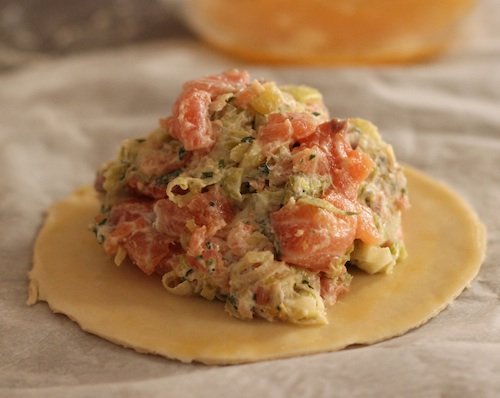
Divide the salmon mixture into 4 even portions and pile a portion in the centre of each of the smaller pastry circles, leaving a margin of about 2cm all the way around. Brush each margin with a little of the beaten egg. Cover each with a large pastry circle, pressing around the edges to ensure a good seal. Trim away any excess overlapping pastry to leave a neat edge. 


Trim...


Using a small sharp knife make a small hole in the centre of each pie to let steam escape while they cook.  It is traditional to score the surface of each pie with semi-circular lines radiating out from the centre.


Score...


Refrigerate the Pithiviers until needed.

When you are ready to bake, pre-heat the oven to 180°C (fan). Place the pies on a non-stick baking tray or one lined with baking paper and brush with beaten egg before baking in the pre-heated oven for about 25-30 minutes or until risen and golden.


Share...

Serve hot or cold with a salad.


Pin It

Thursday, March 24, 2016

Hot Cross Buns – and an Invitation to Commit Gluttony!

Pin It
Hot Cross Buns are traditionally eaten on Good Friday. These ones will lead you into temptation. 


As a child, one of the great treats of staying with my Gran in Cork City was that her local bakery produced great Hot Cross Buns at Easter. Maybe my taste buds are suffering from nostalgia, but I haven’t been able to find a bakery since that can produce a bun of comparable deliciousness. Many commercial versions taste like a mouthful of sawdust – a penance indeed. Experience has taught me that these Easter buns are a creation often best baked at home.
Easter is thought to be named after the Anglo-Saxon goddess of Spring, Eastre, and some believe this sweet spiced bread was baked in her honour. It makes much more sense to me that these sticky treats are a celebration of springtime and abundance to come rather than an invitation to commit Gluttony in the dying days of Lent. Whatever you believe, they are delicious.

For 12 tempting buns, you will need...
... to preheat the oven to 190°C at step 7

For the dough
500g strong white flour (bread flour)
1 teaspoon fine table salt
1 teaspoon ground cinnamon
1 teaspoon grated orange zest
1 sachet of dried yeast (7g)
1 tablespoon olive oil
75g ready-to-eat dried apricots, cut into small pieces (about the size of sultanas)
50g sultanas
75g honey*
300mls fresh milk
1 large egg, beaten 

a little extra olive oil for oiling the work surface and your hands for kneading

For the cross decoration
2 tablespoons plain flour
2 tablespoons water 

For the honey glaze
One tablespoon runny honey, warmed (I put it in a heatproof bowl and stand the bowl in hot water).
Remember that scene from Fried Green Tomatoes...
Put the flour, salt, ground cinnamon, orange zest, dried yeast, olive oil, dried apricots and sultanas into a large bowl. Mix to combine.

*Weigh the honey directly into a small saucepan and add the milk. Warm the milk to between 27°C - 35°C (this is when a finger dipped in the milk will feel neither hot nor cold – but best to use a thermometer).

Make a well in the centre of the flour mixture and add the beaten egg, and about half the milk. Mix with a wooden spoon or spatula and continue adding the milk until you have a soft dough and no dry flour remains. You may not need to use all the milk. Continue mixing until the fruit is well distributed throughout the dough. (You could use a stand mixer with a dough hook either.)

I am shifting more and more towards the no-knead method so I simply cover the dough with a lightly oiled sheet of cling film and leave it in a warm place to rise until doubled in size. (If you prefer, knead it by hand for about 8 minutes or in your stand mixer for about 4 minutes before covering and leaving to rise.)

After the dough has risen, turn it out onto a lightly oiled work surface, and knock it back. (This simply means giving it a couple of jabs with your fists to remove most of the air so you can form it into its final shape.) Knead lightly for a minute or so, before dividing into 12 equal portions. Roll each portion into a ball on the oiled surface, and flatten slightly into a bun shape. Line a baking tray with non-stick baking parchment and gently transfer the buns to the tray. Cover the buns with lightly oiled cling film and leave in a warm place, until once again doubled in size. Make sure the buns have plenty of room to rise.


Meanwhile, make the paste for the cross by mixing together the flour and water - you want a smooth paste with a consistency similar to porridge.

When the dough has once more doubled in size, remove the cling film. Carefully pipe the cross shape onto each bun. Transfer to the pre-heated oven and bake for 10 – 12 minutes or until golden brown. Transfer the buns to a cooling rack and immediately brush them with warmed honey.


An orange blossom honey makes the perfect glaze

It is considered good luck to share these buns and the cinnamon and orange make them particularly good with coffee so what better excuse to invite some friends over! 
Lead me not into temptation... well, perhaps just the once!
This recipe was first published in April 2012 and is back by popular demand!
Pin It