Showing posts with label St Paddy's Day. Show all posts

Sunday, March 13, 2016

Guinness Chocolate Cake – a piece of this is your only man!

Pin It
In true Irish style, Paddy's 'Day' 2016 is set to last 3 days. If you happen to be in Dublin, check out what's on and remember to knock up a quick batch of Guinness Chocolate Cake to keep your energy levels up.


When money's tight and hard to get
And your horse has also ran,
When all you have is a heap of debt -
A pint of plain is your only man.
(The Workman’s Friend, Brian O’Nolan)
You’ll often see visitors to Dublin with what I call “Guinness face”, poised over a glass of the black stuff, feeling that they must taste the local brew but reluctant to put their lips near something that looks like it might have been scooped from the nearby Liffey.
If you are a Guinness virgin, wait until you are in Ireland to try this beverage. Although there shouldn’t be, there is a world of difference between the flat bitter stuff I’ve been served in bars in the UK or the States and a creamy mellow jar of the stuff in its native land.
Among the many pubs that pull a decent pint of Guinness are: Johnnie Fox’s in the Dublin mountains; Kehoe’s, just off Grafton Street; Davy Byrnes, also just off Grafton Street and a stopping point for James Joyce fans; and one of my favourites, The Stag’s Head, (just off Dame Street) a tavern almost as old as Guinness, and probably as close as you’ll get to a proper traditional Irish pub -  not a shamrock or leprechaun in sight.

If you are unable to make it to the Emerald Isle to paint the town green on Paddy's Day, well then, a piece of this rich dark Guinness Chocolate Cake is your only man. 

For one tray bake (15 generous pieces) or 8 mini cakes you will need...
... to pre-heat the oven to 160
°C
Cake Batter

300g Muscovado sugar (or other dark brown sugar)
280g plain flour
40g cocoa powder, sifted
1 teaspoon baking soda, sifted
1 teaspoon baking powder, sifted
¼ teaspoon salt
250mls sunflower oil (or other flavourless cooking oil)
250mls Guinness (or other stout)
2 eggs, beaten
1 teaspoon vanilla extract 

1                    Lightly butter and base-line an 18cm x 26cm (9” x 13”) baking tin.
2                    In a large mixing bowl, combine the sugar, flour, cocoa powder, baking soda, baking powder and salt.
3                    Place the oil, Guinness, beaten eggs and vanilla extract together in a large jug and whisk to combine.
4                    Gradually add the oil mixture to the flour mixture, stirring together with a whisk until no dry mixture remains.
5                    Transfer the mixture to the baking tin and place in the preheated oven for 35 – 40 minutes until well risen. To check if it is done, lightly press the surface of the cake with your finger. If it springs back it’s done. If a small indent remains continue cooking for a further 5 minutes then test again. Alternatively, poke a cocktail stick into the centre of the cake and if it comes out clean (i.e. no damp batter clinging to it, it’s done). Remove from the oven and leave to cool in the tin.
6                    While the cake is cooling, make the frosting.  

Cream Cheese Frosting
100g full fat cream cheese
50g butter, at room temperature (i.e. soft)
350g icing sugar, sifted
1 tablespoon Guinness
½ teaspoon vanilla extract 

7       In a medium mixing bowl, beat together the butter and cream cheese until combined. Add one-third of the icing sugar and slowly beat until smoothly blended. Add in the rest of the icing sugar, the Guinness and the vanilla extract and continue beating until light and fluffy. This will take about 3 minutes.  Transfer to the cake using a spatula, or pipe in generous swirls. 

Note:  For the mini cakes shown in the photos, I carefully removed the cooled cake from the tin and stamped out 8 mini cakes using a 6cm (3”) round cutter before piping on swirls of frosting. The scraps of cake can be used for trifle or cake pops.
Sorry Brian, sometimes a cup of tea is your only man!

First published in 2012
Pin It

Sunday, March 16, 2014

Chargrilled Salmon with ‘Irelandaise’ - forty shades of green for Lá Fhéile Pádraig

Pin It


After the Rugby yesterday, we should be celebrating St Brian's Day, but let's talk about St Patrick. How very 'Irish' of us to have a patron saint who wasn’t even, well, Irish! Maybe he was chosen because we owe him. 


You see, we ... um... kinda... um... kidnapped the boy Patrick back in the 5th century from our neighbours, the Romans, next door in Wales. Legend has it, we enslaved the poor lad for seven years in miserable conditions. We didn’t even have the good grace to give him back. He escaped in the end.

Perhaps suffering from Stockholm Syndrome, Patrick returned and – according to myth – spent 30 years preaching and rooting out snakes (aka pagans) – although it is entirely possible that legend has him confused with another Roman who was also wandering the island at around the same time trying to convert us heathen folk into god-fearing Christians.
Moving swiftly on, by 15 centuries or so, and things have changed quite a bit. We no longer have to kidnap people to bring them to our shores. They come quite willingly.
People come for the breath-taking scenery (Put Glendalough on your “Things to do before I die” list. As far as I’m concerned, on a sunny day, there is no better place.)

They come for the renowned cead mile failte – ‘a hundred thousand welcomes’ – it may have slipped to ‘ninety-nine thousand welcomes’ over the Celtic tiger years but you’ll still find most of the 5 million or so natives more than friendly and helpful.
People come for the culture, the music, the literature (every last one of us is a writer – it’s obligatory).

They may not come specifically for the Guinness, however (despite Diageo’s protests to the contrary) Guinness definitely tastes better in Ireland than anywhere else, and even then there are some places which can pull a better pint than others.
People come for the food – for the cold, clear seas that produce wonderful seafood; for the clean rivers that surrender salmon and trout to patient souls; for rolling countryside (available in at least forty shades of green) that yields gold ingots of outstanding butter, and superb lamb and beef.

The food traditionally associated with Patrick’s Day isn’t particularly lavish – it’s simple, filling, peasant grub which is exactly what you’ll need to shore you up if you are planning to attend a parade. If however, like me, you are planning a lazy day punctuated with bouts of reclining in front of the telly, here’s a quick and easy dish that uses butter instead of oil in a mayonnaise-style sauce - 'Irelandaise'. This recipe makes about 8 times more sauce than you need but that's good news as it is great on steamed veg, baked potatoes, grilled chops etc.


For a lazy fish dish for 2, you will need

‘Irelandaise’
1 large egg yolk
1 teaspoon Dijon mustard (I prefer the extra strong variety)
¼ teaspoon salt
150g butter, melted and cooled to room temperature
1 teaspoon fresh lemon juice 

2 tablespoons very finely chopped fresh chives
2 tablespoons very finely chopped fresh parsley
1 teaspoon finely chopped capers 

Grilled Salmon
2 salmon steaks or fillets
a little extra virgin olive oil
a pinch of salt and a little freshly ground black pepper

Method
[This sauce contains raw egg - the usual warnings apply]
First make the ‘Irelandaise’: Place the egg yolk in a bowl and add the mustard and salt. Whisk together until the mixture thickens slightly. An electric whisk is best for this.
Trickle about a teaspoon of melted butter into the mixture and whisk until it has completely disappeared. If you add the butter too fast the mixture will split. (See the fix at the end of this recipe to remedy this if necessary.) Repeat this trickling and whisking process until you have used about a third of the butter, allowing it to disappear into the mixture before adding the next drizzle. The mixture should start to thicken.
Slowly and steadily, trickle another third of the butter into the mixture, whisking all the time. The sauce should be thick and creamy by now. Now add the lemon juice, which will thin it out a little, and whisk until combined before whisking in the remaining butter at a slow trickle.
Stir in the herbs and capers. Cover until required. At room temperature this will remain soft, and similar in texture to mayo. In the fridge, it will harden. Either way, it goes beautifully with grilled fish, and is pretty good used for garlic bread, on baked potatoes, on steamed vegetables.
For the grilled salmon: lightly oil the fish and season it with salt and black pepper. Place on a medium-hot grill pan (or frying pan). Cook for about 3 minutes, skin-side down. You'll see the colour change as the fish cooks. When it has crept about half-way up the fish, gently turn it and finish cooking on the other side for a further 3 or so minutes, or until the flesh is not longer translucent.  The crispy skin is delicious too.

Serve with vegetables and a swirl of ‘Irelandaise’.


Tip
If your ‘Irelandaise’ splits (or curdles) simply take a fresh bowl, add a new egg yolk, and slowly add the curdled mixture, a little at a time, beating between additions until the curdled mix is incorporated.
Pin It

Friday, March 16, 2012

‘Irish’ Eggs – Green, White and Gold for Paddy’s Day !

Pin It

I have horrible memories of my one appearance in the Dublin Paddy’s Day parade. I washed my costume the night before and it hadn’t quite dried the following morning. It actually formed a layer of frost while we waited for the parade to begin, only thawing out as I high-kicked my way down O’Connell Street. I was aiming for ‘glamorous’ but as I was a pale shade of blue under my fake tan, I think I achieved ‘Smurf’. Brrrrrr.
Traditionally the booziest day in the year, the Dublin parade has evolved from concentrated one-day Oktoberfest, to a more civilised week-long festival with plenty of interesting things to do besides consume vast lakes of Guinness.
While I try to get to some of the events, the best place to catch the parade is at home, in front of the TV, with suitably-coloured food to snack on. There has to be green. There has to be white, there has to be gold.
In my family home, the traditional meal was always bacon and cabbage with mashed potato and turnip so there was the green, white and gold of our flag on the plate. Keeping the colours in mind, and keeping in mind that our national saint’s day has gone all sophisti-mi-cated (to be said in a Dub accent), here is a wee snack for the day, an Irish version of the ‘Scotch’ egg, wrapped in a parsley colcannon. Make sure to use a floury potato.
For 12 ‘Irish’ eggs (feeding 4 people as a canapé) you will need...
… a deep fat fryer
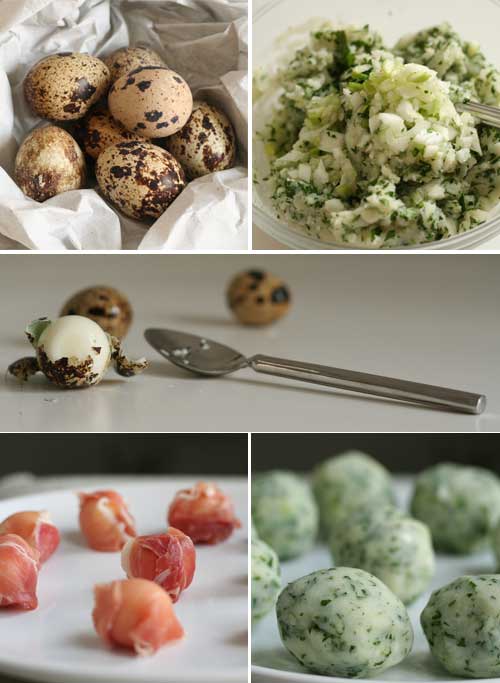
12 quails’ eggs
4-6 slices of proscuitto or other cured ham (optional), cut into strips
360g freshly cooked mashed potato, simply seasoned with salt and white pepper, and cooled (don’t add butter or milk when mashing – you want this mixture as dry as possible).
4 tablespoons very finely chopped fresh parsley
1 spring onion, very finely chopped

Coating
6 tablespoons plain flour
2 large eggs, beaten
100g dried breadcrumbs

Sunflower oil for deep frying


1          First, hard boil the eggs by placing them in a saucepan of cold water, bringing them to the boil and boiling for 90 seconds. Drain the saucepan carefully and fill with cold water to cool the eggs quickly (otherwise you end up with that nasty green ring around the yolk – not the look I’m going for). Peel the eggs and leave to one side while you prepare the rest of the ingredients.
2          Add the parsley and spring onion to the mashed potato and mix well.
3          Pat the quails’ eggs dry with kitchen paper and wrap with the strips of prosciutto.
4          Take a walnut-sized portion of the potato mixture in the palm of one hand and with the other, pat it into a round approximately ½ a centimetre thick. Place one of the quails’ eggs in the centre of the mixture and carefully enclose it in the potato, adding a little more potato if necessary to seal it in. (Be careful not to trap air, which would expand when frying and cause the package to burst.) Roll gently between the palms of your hands to form a smooth egg shape. Place on a tray and continue until you have enclosed all the eggs similarly. Refrigerate until ready to cook.
5          When you are ready to eat, set up a dipping station: Place the flour in a shallow bowl. Place the beaten egg in another shallow bowl beside it. Place the breadcrumbs in yet another bowl.
6          Carefully dip the prepared eggs in the flour, then the egg, then the breadcrumbs. Follow with a second bath of egg and a second coating of breadcrumbs, patting gently to ensure a good stick. When you have coated all the eggs, heat your deep fat fryer to 180°C.
7          When the oil is at the correct temperature, place the prepared eggs in the basket – don’t overcrowd them or you’ll lower the temperature and the end result will be oily and horrible - and carefully lower into the hot fat. Cook for 3 minutes or until golden brown. Drain on kitchen paper and serve immediately – unlike their ‘Scotch’ cousins, they don’t hang about.

Green, white, gold (and delicious)

Are these finicky? Yes.  Are they worth it? I think so. Happy St Patrick’s Day.
Pin It